Product Genius, the Podcast for Inventors, Entrepreneurs, and Startups
Honest advice for inventors—with obscure cultural references included at no extra charge.
Episode
222
Yes, Virginia, There Are Bad Ideas
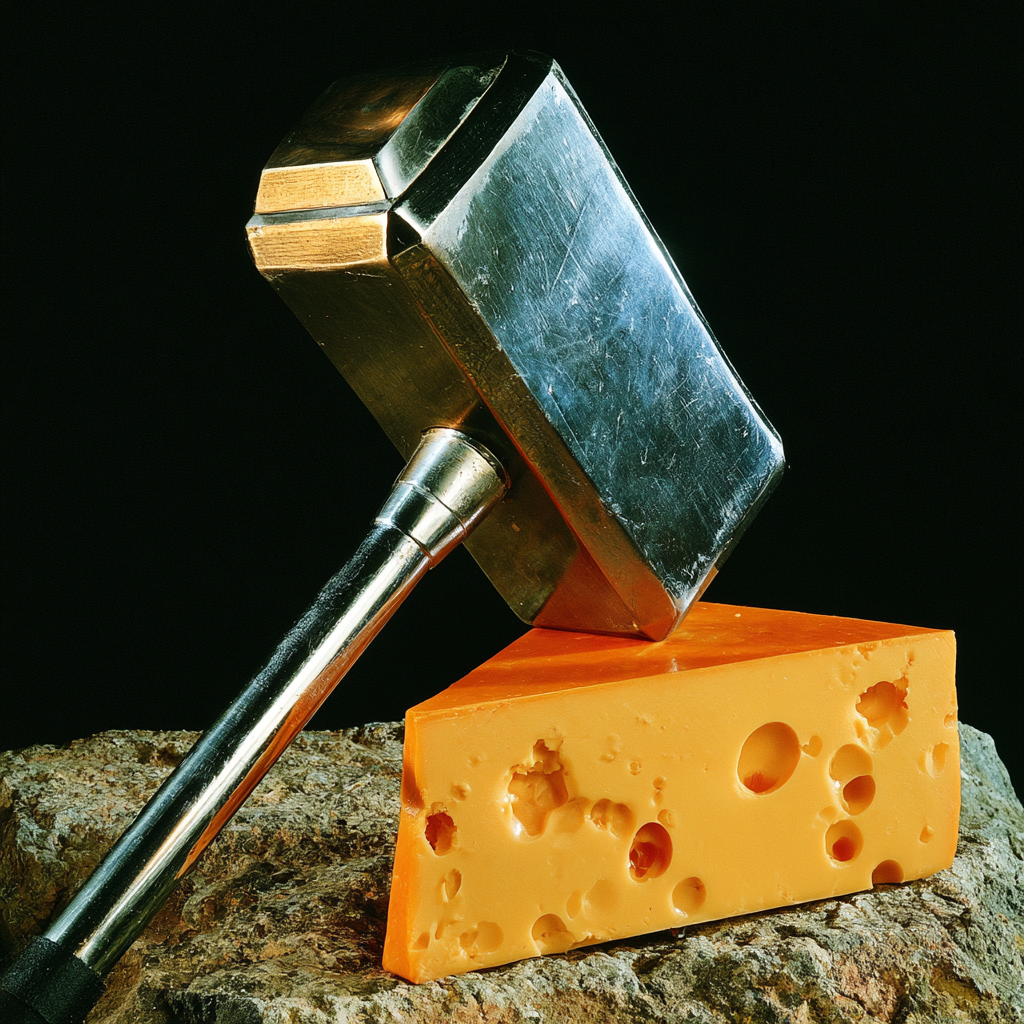
Yes, there really are bad ideas—and that’s exactly why brainstorming can be so valuable. Noah and Steven pick up where Episode 220 left off and explore what inventors should actually do with the pile of concepts that comes out of a brainstorming session. From sorting and ranking ideas against real-world success criteria to reverse-brainstorming the failures and using DFMEA-style thinking to ask what might go wrong, they show how bad ideas can expose hidden requirements, improve stronger concepts, and ultimately lead to better products. Frank’s Cheese Hammer may still be doomed, but even Frank might accidentally teach us something useful.
Core Topics for this episode:
- Product Ideation
- Product Development Process
Key Takeaways Include:
Listen here:
Episode Blog
Yes, Virginia, There Are Bad Ideas: What to Do After a Brainstorm
Brainstorming is supposed to be a judgment-free zone.
That is useful advice—during the brainstorm.
Afterward, however, somebody has to look at the whiteboard covered in scribbles, half-formed concepts, improbable mechanisms, and at least one idea involving Frank’s Cheese Hammer and decide what deserves to survive.
That is where the real work begins.
In this episode of Product Genius, Noah McNeely and Steven Julian continue their discussion of brainstorming and ideation by focusing on what happens after the creative storm. The goal is not to mock bad ideas or throw them away as quickly as possible. It is to organize, evaluate, improve, and sometimes salvage them.
Because yes, there are bad ideas. But bad ideas can still be useful.
Brainstorming Is Only Half the Process
A brainstorming session can create dozens—or hundreds—of ideas.
That feels productive. The room is energized. The whiteboard is full. Everyone leaves thinking something important happened.
But if those ideas are saved in a folder and never examined again, the brainstorm accomplished very little.
Noah compares this to cleaning up after a storm. The brainstorm creates the debris. The value comes from sorting through it afterward.
A productive ideation process therefore has two distinct phases:
- Generate ideas without prematurely judging them.
- Evaluate and improve those ideas with discipline.
Skipping the second phase is one reason people become cynical about brainstorming. They remember corporate retreats where everyone generated pages of concepts but nothing ever changed.
The problem was not necessarily the brainstorm.
The problem was the lack of follow-through.
Step One: Categorize and Consolidate
Start by organizing the ideas.
Do not create one pile labeled “good” and another labeled “bad.” That is too early and too subjective.
Instead, look for meaningful categories.
If you were developing a product for breaking hard cheese—because apparently we live in a world where this is now necessary—your categories might include:
- Mechanical solutions
- Electric solutions
- Cutting solutions
- Crushing solutions
- Commercial-use ideas
- Home-use ideas
- Portable concepts
- Automated concepts
As you sort, you will often discover that several ideas are really variations of the same concept.
Merge them.
One person may have suggested a lever. Another proposed a hinged press. Someone else imagined a desktop crushing device. Those may ultimately represent one family of solutions rather than three unrelated ideas.
This consolidation reduces clutter and makes the next step much easier.
Step Two: Define Objective Success Criteria
Inventors often evaluate ideas emotionally.
“I like this one.”
“I don’t like that one.”
“This one feels right.”
Those reactions are not useless, but they are incomplete.
The important question is: why?
If you love a concept because it is compact, then size may be an important success criterion.
If you like another concept because it looks premium, appearance may matter.
If you reject an idea because it requires expensive electronics, cost may be critical.
Possible criteria might include:
- Manufacturing cost
- Product size
- Weight
- Safety
- Ease of use
- Durability
- Appearance
- Manufacturability
- Patentability
- Assembly complexity
- Retail price
- Customer appeal
- Maintenance
- Sustainability
Once those criteria are explicit, ideas can be compared more objectively.
This process can reveal something even more important: sometimes you discover that your original criteria were wrong.
Noah recalls working on a brainstorming project for a large company where the team evaluated concepts using the requirements they had been given. When the ideas reached the CEO, he disliked the highest-ranked concepts and preferred others that had scored poorly.
That sounds like a failed process.
Instead, it revealed hidden requirements.
The CEO had criteria he had never articulated because he did not realize they mattered until he saw the actual concepts.
The team updated the criteria, brainstormed again, and ultimately developed stronger solutions.
That is not failure.
That is discovery.
Step Three: Reverse-Brainstorm the Bad Ideas
Suppose an idea scores poorly.
Do not immediately delete it.
Ask why it failed.
Maybe one part of the idea solves a problem none of the leading concepts address.
Maybe the overall concept is ridiculous but contains one useful feature.
Maybe the weakness exposes a requirement you had not recognized.
Noah calls this reverse brainstorming.
Take the bad idea and ask:
“How could I make this as good as possible?”
Imagine someone suggests a levitating cheese hammer.
That sounds useless—and almost certainly is.
But what was the underlying thought?
Maybe the person was trying to eliminate the need to hold the tool.
That could lead to a mounted device, a spring-loaded mechanism, an automated press, or a hands-free fixture.
The levitating hammer disappears.
The useful insight survives.
This is why brainstorming sessions should not punish strange ideas. The odd suggestion may contain a small piece of something valuable.
Improve the Bad Ideas on Purpose
One useful exercise is to force yourself to improve every weak concept.
You do not need to spend hours on each one. Give yourself a reasonable time limit.
Ask:
- What is useful about this?
- Why did someone suggest it?
- What problem is it attempting to solve?
- What would have to change for it to work?
- Can one feature be transferred into another concept?
- Does this reveal a requirement we overlooked?
Some ideas will remain bad.
That is fine.
The purpose is not to rescue everything. The purpose is to extract whatever knowledge is hiding inside the failure.
This also protects the team from prematurely discarding ideas simply because they are unfamiliar.
Step Four: Design for Failure
Once you have a few promising concepts, change the question again.
Stop asking:
“How great is this?”
Start asking:
“How will this fail?”
Engineers formalize this kind of thinking through tools such as DFMEA—Design Failure Mode and Effects Analysis.
The name sounds like something created specifically to make non-engineers leave the room.
The basic idea, however, is simple.
For each concept:
- Identify the ways it could fail.
- Consider the consequences of those failures.
- Find ways to reduce or eliminate them.
For a physical product, failure modes might include:
- A component breaks
- The product tips over
- A user can pinch a finger
- Water gets into electronics
- A mechanism jams
- The product is too heavy
- Assembly is confusing
- The design costs too much to manufacture
- Customers misunderstand how to use it
Not every failure is a mechanical failure.
A product can function perfectly and still fail commercially because it is too expensive, ugly, inconvenient, difficult to ship, or aimed at the wrong customer.
That is why Product Genius tends to think about failure broadly.
Ask What Might Go Wrong
Steven jokingly proposes replacing DFMEA with the less intimidating acronym WMGW:
What Might Go Wrong?
That is actually a useful way for inventors to think about it.
Take your leading concept and deliberately imagine everything going badly.
A customer drops it.
A child misuses it.
The factory changes material.
The product sits in a hot car.
The battery dies.
A moving part jams.
Customers refuse to read the instructions.
The retailer insists on different packaging.
Shipping costs twice what you expected.
Then ask:
“What would we change now to make that less likely?”
The earlier you ask these questions, the cheaper the answers usually are.
Finding a problem on paper is inexpensive.
Finding it in a prototype costs more.
Finding it after tooling is expensive.
Finding it after shipping 10,000 units is the kind of lesson nobody wants.
Make the Best Ideas Better
Post-brainstorm evaluation is not only about rescuing weak concepts.
Your strongest ideas should also be challenged.
An idea can win the first round and still have serious weaknesses.
Try to break it.
Combine it with features from other concepts.
Ask whether the best parts of the second-place idea belong in the first-place idea.
Challenge the assumptions underneath it.
This is where the brainstorming process becomes iterative rather than linear.
You do not simply generate twenty ideas and crown a winner.
You generate twenty ideas, organize them, evaluate them, combine them, attack them, and improve them until something stronger emerges.
Avoid Analysis Paralysis
There is a danger on the other side.
You can analyze forever.
At some point, evaluation stops reducing risk and starts preventing progress.
Noah suggests that the post-brainstorm process should generally take a reasonable amount of time—a day or two in many cases, not three weeks of endless debate.
The exact timing depends on the complexity and stakes of the product, but the principle is important:
Brainstorming is supposed to create forward movement.
If you are still ranking color-coded sticky notes a month later, something has gone wrong.
The Product Genius Take
A brainstorm is not valuable because it produces a lot of ideas.
It is valuable because it produces better decisions.
That requires both creativity and criticism—but in the right order.
During brainstorming, protect the creative process. Capture the strange ideas. Let Frank talk about the cheese hammer. Do not attack people or concepts before they have room to develop.
Afterward, switch modes.
Categorize the ideas. Define objective criteria. Improve weak concepts. Pull useful features from bad ones. Identify hidden requirements. Then take the strongest candidates and aggressively ask how they might fail.
The goal is not to prove your favorite idea is brilliant.
The goal is to discover the strongest product you can build.
And sometimes the route to that product runs straight through a few wonderfully bad ideas.
Or, read the full transcript here:
Steven Julian
Yes, Virginia, there are bad ideas. And we're going to be talking about bad ideas and bad ideas out of brainstorming for inventors and entrepreneurs. And also, we want to apologize to all the Franks out there. Although Frank of Frank's Cheese Hammers, you can go to hell. Next on Product Genius. Do you want to be a successful inventor entrepreneur struggling to get your product from idea to market? Well, you've come to the right place. Welcome to Product Genius. The down-to-earth podcast that explores important topics about inventing and launching new products. Noah McNeely is your trusted guide.
With more than 20 years of product launch experience, he's here to help you on your journey to become a product genius. Let's get started. Here's your slightly annoying co-host, Steven Julian. Hey, that's my line. Greetings and salutations, everybody. It is your slightly annoying co-host, Steven Julian. Welcome to another what might be, hopefully, maybe one day, an award-winning edition of Product Genius coming to you semi-live. Well, we're live. You're not listening to this live. Anyway, we're coming to you from the lair inside Product Quick Start. With me, as always, is our intrepid producer, Jody Smith.
And. across the table from me is the man you all came to listen to, he who is known as Noah McNeely. of Product Genius.
Noah McNeely
Hello.
Steven Julian
Hello. Happy day. We have had a fantastic pre-show meeting where we have just sat around talking about life, talking about our kids. Talking about other things that we're not going to bring up on air, but they're just for us, right?
Noah McNeely
It was the kind of conversation you might have in a bar, but we haven't even been drinking.
Steven Julian
No, just coffee from your wonderful machine. I had the Southern Pecan, I believe. Yes. And Jody had the same. I think you had the same.
Noah McNeely
We all did Southern Pecan.
Steven Julian
The one thing we didn't do is pumpkin spice. And that's a topic for another show.
Noah McNeely
Yeah, that's on the bad ideas show.
Steven Julian
That's right. And this is the bad idea show.
Noah McNeely
Which I know is a polarizing thing to say. Exactly.
Steven Julian
But so is saying someone's idea is a bad idea. I believe the working title of this show is Yes, Virginia. There are bad ideas. So we have... We're going to talk about brainstorming and we're going to talk about when you're. an inventor, entrepreneur, and you're kind of doing some brainstorming and people brainstorm with you, Noah, all the time. That's kind of part of your job is to help them through their brainstorming. They bring their brainstorms to you. And we phrased it as sometimes you have to call the baby ugly. Sometimes you have to call the idea a bad idea.
So we're going to kind of talk about that. And I think we have a fictitious sponsor for this show.
Noah McNeely
Well, we don't know that they're fictitious for sure. They might be out there. And if you're listening, we would love you to sponsor this show.
Steven Julian
We're already giving you free marketing.
Noah McNeely
That's right. So, yeah, today's show is brought to you by Frank's Cheese Hammers. And, of course, therefore, those very special occasion when cutting the cheese is simply not enough.
Steven Julian
And just to kind of recover that bad idea. We are actually sponsored by a real product. You guys that know Tiffany know that she has gone off and has been launching Opu Probiotics. And Opu actually is a legit product.
Noah McNeely
It is a legit product. And from personal experience, I don't think it's too far. for me to go to say that Opu really helps avoid the need to cut cheese.
Steven Julian
Tiffany, that's free marketing for you. From Noah's idea, but I fully support it and wish I had come up with it myself because it's pretty darn funny. Okay. Brainstorming. You know, when people talk about brainstorming and you kind of wrote that, you kind of sent me this as we were discussing notes back and forth.
Noah McNeely
And this is part two of two. Yeah. The last time we talked about all the good stuff with brainstorming. Right. Now we're on the other side. We're going to talk about the dark stuff.
Steven Julian
The dark side of brainstorming. So when you've talked about brainstorming, there are books and gurus who will say, hey, there's no such thing as a bad idea in brainstorming. And you say to that, well, that's stupid.
Noah McNeely
And which, you know, to be fair, you don't want to say that during brainstorming when people do throw out bad ideas. If you say that's stupid. Well, that's not going to go well.
Steven Julian
It shuts down the creative process, too.
Noah McNeely
They're not going to throw out any other ideas, whether they're good or. bad. And I think the point there is, yes, there are bad ideas, but in a brainstorm, we want those bad ideas, too. And that's really the point that those books are trying to make. They just make it in a weird way. I think people that have had bad brainstorming experiences, they've latched onto that, and they just end up with this long list of bad ideas, and they don't know what to do with them.
Steven Julian
Right. So let's talk about what we can do with some of those bad ideas. So the first piece of advice Noah gives you is if you're in a brainstorming session, don't say in the middle of the session, hey, that's a horrible idea.
Noah McNeely
No, don't criticize the idea. Don't criticize the person. No personal attacks. You're an idiot. That's a stupid idea. Shut up. That's a bad thing to say.
Steven Julian
Because it's going to ruin what might then follow as a better idea or a good idea. So after the brainstorming session is over, So now is there anything to be done with bad ideas? Is it just they're worthless? or can you turn bad ideas good? Is there any value at? all in the stack of notes that you've created?
Noah McNeely
Yeah. So is there hope for these bad ideas? Can we find any value in the stack of scribbles and notes? Or are these ideas, are they just destined to a life of petty crime? Are they always going to be bad or can we make them useful and valuable?
Steven Julian
I don't know. Are you?
Noah McNeely
Well, I have some stuff written on my sheet here.
Steven Julian
Well, let's start talking. Well, and yeah, so I think you came up with four things to kind of walk us through to clean up after the storm. Right.
Noah McNeely
So before I reveal the four things, which are not in the book anywhere, so people might disagree with them, but they're my four things. I'm going to tell. There used to be, and I'm not going to mention the name of the company or the person, but they're reasonably famous, especially in this industry. They would do these brainstorming camps. It was like a two-day thing, and they would sell them to these big companies, and these big companies would go in, write a big check to send 20 of his people up to this camp. in a secluded area, and they'd spend two days brainstorming.
And I've seen some of the reports that came out of that, and it was really just that big long list of mostly bad ideas. You have a few good ones in there, but I'm pretty sure most of those reports went promptly into a folder and were forgotten because nobody took the time or went through a process of dealing with the post-brainstorm activity of cleaning up after the storm. They left all the limbs. It's like a hurricane came through and they left all the trees down. They didn't go in and clean up.
There was no positive result in a lot of cases. So those were bad brainstorms because they only did half of it. They didn't do the back half. And that's digesting and doing these four things and other things that we'll talk about.
Steven Julian
All right. So number one, I believe probably based on what you just said, probably the first thing is to get a little. To organize or to categorize.
Noah McNeely
Yeah, and I don't mean to have two buckets, one for good ideas and one for bad ideas. We're not going to put. all Frank's ideas in the bad idea bucket. Let's just move on. That's not what we mean. But oftentimes, when you are brainstorming, you've had a problem statement. We talked about this in the last show, I think, where the brainstorm had a purpose. Okay, we're going to brainstorm ways to... Break cheese into crumbles, you know, so you're going to come up with all.
Steven Julian
Well, that's already been solved with Frank's cheese hammer.
Noah McNeely
This is what we call hypothetical, you know, it's not a real example. So it may have been for Frank once upon a time. By the way, I lost my train of thought.
Steven Julian
Dozens of listeners right now are Googling Frank's Cheese Hammers to see. Is there a Christmas after Christmas special on those?
Noah McNeely
Oh, absolutely. I mean, if you need to break cheese into randomly sized crumbles, there's no better way.
Steven Julian
So here's what your slightly annoying co-host does. Categorize and sort. Yes.
Noah McNeely
So for breaking cheese up, maybe you've got... The categories are, okay, I'm going to have physical, you know, mechanical solutions, you know, then maybe I'm going to have a bucket that's electric solutions and then maybe a bucket of, you know, chemical solutions or whatever it is, you know, it could be any number of things, depending on the problem you're trying to solve. Maybe it's solutions for homeowners or, you know, individual people in their kitchen. Maybe there's also a bucket of solutions for commercial cheese breaking, you know, whatever that is, but you break everything up into these different.
Kind of buckets and categories. Then you can start to sort things and then you'll start to see, okay, well, these two ideas, they're really kind of two versions of the same idea. So you start to merge those together and that makes the task of taking all these, you know, what was hopefully several dozen ideas and really consolidated them. So you can attack that analysis a little bit easier.
Steven Julian
So once you've organized, I think your step two then is you kind of have to bring in. An outside criteria that you've got to rank it against something. So talk about, okay, I got these ideas. Now, I guess it's the first step of kind of being, now I got to get into the real world.
Noah McNeely
Yes. Go for it. Yeah. So it's important to be objective in. how you critique these ideas. And by objective, I don't mean. I don't like that idea because it was Frank's.
Steven Julian
Poor Frank is really getting beat up in this show.
Noah McNeely
Yeah, we had to pick on somebody.
Steven Julian
So why not a fictitious cheese hammer inventor?
Noah McNeely
If there's a Frank out there crying about this, we're not picking on you. It's a different Frank. So you need objective criteria. And some people actually have trouble with this. Inventors I've worked with, it's like, they're just, I like this one, I don't like that one. They don't really necessarily think about why. So one of the things I advise them to do, Okay, you really love this idea. Maybe it's the first idea you came up with, and that's fine. Take a step back and try to figure out what are the things you like about it.
And it can't be, oh, because I came up with it. That's not an objective reason. Do you like it because it's the right size? Do you like it because, hey, it's really cool looking? Well, maybe those become your criteria. Maybe my product has to be really cool looking. That's okay. That can be. a criteria. Maybe it's... My product has to be really small so kids can use it. Well, that becomes a criteria. So try to boil down what it is you like about something. Even if that's kind of nebulous, try to turn that into really concrete things because then you can take that and then filter all the other ideas through that and then say, okay, well, I didn't like this one because it's not cool looking.
Okay. And, you know, we'll move on to step three in a minute. I'll talk about what to do then.
Steven Julian
Well, I think this might be a good point after step two here. You gave some good ideas of what it might look like. I would imagine you've got a couple of real-life stories. Names can be changed to protect the innocent other than Frank. We're just berating him this entire show.
Noah McNeely
Frank's going to take all the abuse.
Steven Julian
Yeah, but I believe, you know, so is there a specific example you can give? Last few years that, you know, maybe you help someone kind of create that success criteria, objective criteria, objectively, you know, kind of look at their idea in the. real world.
Noah McNeely
Yeah. So this is actually going to be an example, not from my work with inventor entrepreneurs, but I'm going to go a little bit further back in my career. This was actually, you know, even large companies. Have trouble with this in many cases, especially if they don't do a lot of brainstorming. These are the type of companies that will go and hire that brainstorming retreat coach I mentioned earlier just to check off a box.
Steven Julian
Create a folder. Woo, I did it.
Noah McNeely
The CEO says, you guys got to do a brainstorming of this thing. All right, go find someone to do a brainstorm for us. Check out the box and then you can tell the CEO, who's also named Frank, that we did it. But then you don't get a whole lot of value out of that. Companies sometimes don't understand brainstorming if they're not doing it a lot. So even big companies, and this is a case with a large company, we did this, this is a much bigger team I was working with. We had probably a dozen people in this brainstorm.
We had all sorts of ideas in all sorts of. different directions. It was a fairly complicated challenge in a consumer product industry. And we came up with a bunch of ideas and it got to the CEO's desk. We kind of rated them based on the criteria that we were told coming in. It got to the CEO's desk and he hated all the ones that rated well. And he liked a couple of the ones that did not rate well against the criteria we were told early on. I can't really say what those criteria are because that might be crossing the confidentiality line.
But what it turned out, it helped us realize, helped him realize, okay. I've got criteria that I didn't even know I had until I saw these ideas. Now I know what those criteria are. So then we were able to go back, rewrite the ideas. We actually did another brainstorm based on that. We came out with some fantastic things that went on to be a good product.
Steven Julian
I think not only that, your anecdote kind of segues into your third point because your third point is you talk about reverse brainstorming. So what do you mean by that phrase?
Noah McNeely
So reverse brainstorming. is a way to salvage. The one way to salvage bad ideas, ideas that don't rate well. So one thing, if an idea doesn't rate well and you thought it was going to rate well, that may kind of help you identify a negative criteria that you didn't realize you had until you got to that point. The other thing, if an idea rates poorly, dig deep into it. Does that address a problem that's not addressed somewhere else? And is that a problem that we need to think about addressing somewhere else?
It's a rechargeable Frank's cheese hammer that somebody came up with in the brainstorming. You're like, huh, we didn't think about that. We don't want people to have to change batteries in their cheese hammer. So maybe that becomes something that leads to other ideas. That idea gets more robust. And you maybe take that element of that bad idea and you put it into one of the good ideas. So ideas continue to evolve. I think one of the fun things, or for nerdy people like me, or one of the things that can be useful is to force yourself to take every one of the. bad ideas and make it as good as you can.
So, all right, you know, levitating cheese hammer, what can I do with this? Why would anyone want a levitating cheese hammer? You know, another one of Frank's stupid ideas. These are all things to say in my head. Don't say to Frank out loud. Right, right.
Steven Julian
Not during the brainstorming session.
Noah McNeely
No, certainly not. So then you think, all right, what was he getting at there? And then you go down a path. Okay, what's the best I can do with that? Okay, maybe it's a cheese hammer on a stand and you push a button and it does its thing without you having to touch it. That's kind of a levitating cheese hammer and I can see some value there. Sure. That may lead to better and better ideas down the road.
Steven Julian
I like it. Now, I guess in that, maybe you need to set a little bit of a time limit because if you're on the worst idea of all time, And you're like, I literally can't think of anything. Or I thought of something to make it better, but it's still so far from it. Okay, I did it. And then you might be checking a box a little bit, but it does keep you from just throwing all the quote unquote bad ideas away.
Noah McNeely
Yeah, you certainly don't want to kill yourself with analysis paralysis there either, which is, I think we did a whole other show on that maybe once upon a time. I'm sure we did. Yeah, you do set a timeline. If you're spending three weeks analyzing your brainstorm, you're not doing it right. You should spend a day or two.
Steven Julian
We did do that analysis paralysis show, but I believe it was four hours of recording, and Jody's still trying to trim that down to where we can produce it and put it out.
Noah McNeely
We're going over every single word to make sure it's right.
Steven Julian
Absolutely. So your fourth point, I'm going to warn our listeners. Noah always says he's not an engineer, but he plays one on the podcast.
Noah McNeely
I'm a recovering engineer.
Steven Julian
He's a recovering engineer. Sorry, wrong.
Noah McNeely
That's okay.
Steven Julian
Wrong sarcastic phrase. I apologize. That's your line, apparently. So I'm warning our listeners, we're about to get into engineering acronyms. Yes. So you want to talk about what? it could get bogged down or so everybody take a sip of your favorite beverage, hopefully coffee. Stay awake a little bit. We're going to get into acronyms. being an engineer. By the way. You had a funny one. You had a great one, I thought. Engineer is actually an acronym.
Noah McNeely
I didn't know that. It is. If you take the letters to engineer, you work it out. It's eccentric nerd generating innovative, novel, excellent experimental research. And that describes a lot of engineers I've known in my career.
Steven Julian
Including yourself, probably.
Noah McNeely
Some days, yes. Absolutely.
Steven Julian
So you had an acronym talking about leading ideas. Tell everybody what you mean by that.
Noah McNeely
This kind of goes with reverse brainstorming, a process that engineers use, and there's books written on it. And because engineers love acronyms, people just walk around and they say DFMEA. And I think when you're a new hire or fresh out of college engineer and somebody says that, go do a DFMEA, you have no idea what that even stands for, but you know what it is. And what it stands for is design failure mode and effect analysis. And which probably means about as much as. the acronym by itself. But what it is, is you take your leading ideas out of the brainstorm and maybe some that you've improved, some of the bad ideas you've improved.
And what you do, it's another type of reverse brainstorming where you start brainstorming. How does this idea fail? You know, let's say we make this product or make the system this way. Where is it going to fail first? So, you know, the. Cheese hammer stand. Okay, where is it going to fail? What's going to be the failure mode for that in terms of getting it on the market or in terms of whatever? Okay, well, somebody could turn it on and hit their hand. Okay, that's a failure mode. Then you brainstorm, how do I prevent that from happening?
And then the idea gets a little bit better. Maybe the failure mode, one of the failure modes you come up with there, oh, it's going to be too heavy. People don't want to move it around.
Steven Julian
Levitating. Make it levitate. That was one of the ideas.
Noah McNeely
Yes. At this point, we are trying to not throw out as many, quote, science fiction or bad ideas.
Steven Julian
Got. it.
Noah McNeely
Got it. We are trying to connect with the real world.
Steven Julian
Yeah. So if it's too heavy, then we have to pay attention to the weight and make sure that it's lighter.
Noah McNeely
So that's not so much an engineering failure mode, but that would be a product failure mode there because it's too heavy. People aren't going to buy it. They're not going to use it. Then you attack that and say, you brainstorm. How do I? Get rid of that. So, okay, well, instead of making it heavy, let's make it have a wide base. that's lightweight material like plastic. You go through this process on all your best ideas and some of the ones that are kind of mid-level. And oftentimes you find that the idea gets stronger and stronger and stronger.
And, you know, this is a process. I'll sit down with clients when they first come in that have not gone through this type of process. They just had their great idea, which is typical of inventors. It is, in many cases, a good idea. In many cases, it's not. But in many cases, it's a good idea. But they haven't done this and they. haven't asked themselves, okay, how can I make it better? How can I brainstorm making it better? But almost more importantly, how does this idea fail and how do I brainstorm ways to prevent that failure?
And by fail, I mean fail as a product.
Steven Julian
Why didn't they call it WMGW? What might go wrong?
Noah McNeely
Because those are really simple words.
Steven Julian
Right, right.
Noah McNeely
It doesn't let engineers feel superior.
Steven Julian
Eccentric, nerd generating.
Noah McNeely
Engineers need to put big words in their acronyms to make other people feel like they can't possibly understand what engineers do.
Steven Julian
So give us one more time, DFMEA, design fail.
Noah McNeely
Design failure mode and effect analysis. And there's really formal ways to do that. If you're really bored, there's probably books with hundreds of pages that talk about it. I skimmed some of those books, and I took the gist of it, and that's what I do, and that's what's useful.
Steven Julian
Well, in the process at the end of the effect analysis, you come out of it. You don't just say what could go wrong. There's an analysis. Because of that, therefore this. Because of that, we should look at this.
Noah McNeely
It's putting the way I do. it. and the way I think. Most good product developers do it is they put the analysis into an actionable way of making the idea better. They don't just come up with, oh, here's the ways it'll fail. They come up with, okay, for each way it can fail, how do we overcome that? Right.
Steven Julian
So four steps coming out of your brainstorms. First of all, before you get into any of the four steps, recognize that. You're going to have good ideas and there are going to be some bad ideas. We need to at least acknowledge that. Categorize and sort them. Rank against your success criteria. Do some reverse brainstorming with what you consider a bad idea. Can you make it better? Try to improve on the bad idea because you might actually find a good idea in the midst of it. or at least improve your other good ideas and then get into those acronyms.
Be an eccentric, nerd-generating, innovative novel. Excellent experimental research person or at least try to play one and design for failure with an effect. analysis and work from that. So bottom line it for us, Noah. We're coming to the end. Give. us something we can practically take with us. Boy, that sure sounds like a sermon illustration, but go ahead. Preach it. Preach, brother.
Noah McNeely
So bottom line is brainstorms are really only as valuable as the follow-up activity. I mean, if you brainstorm it and put it in a drawer, You know, you've wasted your time. It's about cleaning up after the storm. You know, kind of the analogy I put earlier about the hurricane comes through. You got to go in, you got to clean up the limbs and, you know, tidy up the street and then you can find value in, you know, you can actually find value in the brainstorm that way. Brainstorms do generate bad ideas.
That's okay because bad ideas can lead to good ideas if you try. And another thing is doing the sort of, Brainstorm post-op activities, that may help you make your ideas even better. And even the ones that you thought were great coming out of the brainstorm, that doesn't mean they can't get better. And this is a process that helps you do that.
Steven Julian
So I'll put it in an anecdote in terms of this podcast. We had a great idea. when we started doing this show from here, just off of the offices of Product Quickstart in the lair. Great idea of having a coffee machine, a wonderful little Keurig or a version of a Keurig maker that allowed us to make this great coffee. But there was a design for failure in that I put my coffee in a cup with no top on it. And so sitting at this table, which is a wonderful table, but does kind of shake sometimes, I spilled.
So I had to clean up after the storm and get up. Paper towel. Am I missing the point of the show? Is this a little deeper than that?
Noah McNeely
It's possible. I don't know what you're talking about. We had other failures with that coffee machine too. Once I offered Steven a cup of coffee and I used a cup that was a little too small. So we ended up with coffee overflowing the cup.
Steven Julian
But you know what happens after every storm? Right. We clean up, we work at it.
Noah McNeely
And we made the coffee experience better by saying, okay, we'll just use a beer cup.
Steven Julian
Exactly, exactly. And Noah has moved the creamer. and… The froofy stuff to make the coffee taste better into the fridge. And so, yeah, we continue to clean up after the storm and it's getting better every time.
Noah McNeely
So I should point out this shaky table is, you know, it's an innovation table. Countless great ideas have been developed and broken and put back together on this table. So give the table a break.
Steven Julian
Yeah. Listen, I was not dissing the table. I was working very hard not to diss the table.
Noah McNeely
The table seems a little offended to me. No, boy.
Steven Julian
Well, you know what? I will get it a redemptive gift. I will buy it a Frank's cheese hammer. That'll be perfect. Yeah, that would be great. So stream of consciousness continues here at the end of the show.
Noah McNeely
We need to wrap this up. Yeah, yeah, absolutely.
Steven Julian
Absolutely. So for those people who want to brainstorm with you, Noah, they can go to productquickstart.com. There is a contact us form. All he asks is that you don't say, I want to talk to you about something. Please tell them what they need to do.
Noah McNeely
Yeah, I'd love for you to fill out the form or. where there's questions there. Or if you're going to send me just to contact us for them, tell me a little bit about it. And even though it's probably not great for my business, you'll find that on the first phone call, I'll probably brainstorm with you a little bit. I'm not going to charge you for that. But it's just, you know, I'm kind of a creative guy and that's what I do. Yeah, I'd love to hear from you, and I might not like your idea, so don't be offended if I try to make it better.
Steven Julian
If you're listening to this show also and you go, I know I could do a better podcast than that doofus, annoying co-host, I could do a better show than him, then you need to go to JodySmith.com. He helps people podcast, and he'll even... Probably tell you, oh yeah, of course you could do better than the slightly annoying co-host Steven Julian. Not as good as Noah, but I'll help you get close. So go to jodysmith.com if you want a podcast. Go to productquickstart.com. Find out more about how you can work with Noah.
And if you're looking for an independent financial advisor, you can search my name. Unfortunately, compliance won't let me say any more than that on this show. And I don't know if Noah will either or not. Anyway, I've wasted enough time, but we thank you for being here. And remember, if you're looking for that perfect gift, Frank's Cheese Hammer. So for Noah, for Jody, this is Steven. We will catch you next time on Product Genius.